
 EN
EN
 English
 Español
 عربى
عربى 中文简体
中文简体

-
+86-13616168066

TEL:
-
+86-510-86525168

Fax:
-
No.8 North Huanzhen Road, Mazhen,Xuxiake Town,Jiangyin City,Jiangsu Province,China

Address:
Feel Free To Contact Us :
-
+86-13616168066
-
-

Jul. 17, 2026
Industry News
EPC Flooring: Everything You Need to Know About Engineered Polymer Core
Content
- 1 You See Two Identical Planks — Only the Core Decides Performance
- 2 What EPC Flooring Actually Is
- 3 How an EPC Plank Is Built — Layer by Layer
- 4 Five Critical Benefits That Define EPC Performance
- 5 EPC vs. SPC vs. ABA: The Only Comparison Table You Need
- 6 Where EPC Excels — And Where It Does Not
- 7 Installation: What You Need Before the First Plank Goes Down
- 8 Care and Long-Term Durability
- 9 Making the Right Selection for Your Space
You See Two Identical Planks — Only the Core Decides Performance
In a flooring showroom, EPC and SPC samples often share the exact same surface pattern. The printed decor layer, the wear coat, even the attached underlayment can look identical. Yet underfoot and over time, these two products deliver completely different results in comfort, sound reduction, and thermal stability.
The distinction lives in the core. EPC stands for Engineered Polymer Core — a rigid vinyl flooring technology that blends virgin PVC with a specialized foaming agent to create a lighter, quieter, and warmer slab than traditional stone composite alternatives. That single difference reshapes which product suits a bedroom versus a sunroom, a condo versus a basement.
What EPC Flooring Actually Is
EPC flooring belongs to the rigid core luxury vinyl plank (LVP) family. It emerged as an evolution of WPC (Wood Plastic Composite) but replaced wood flour fillers with an all-polymer core infused with microscopic air pockets. This foamed polymer construction yields a density roughly 60% lower than SPC (Stone Plastic Composite) while preserving dimensional stability nearly as well.
Because the core contains no natural fibers, EPC is 100% waterproof from top to bottom. It will not swell, buckle, or delaminate when exposed to standing water — a critical advantage over traditional laminate or engineered hardwood.
Specifications vary by manufacturer, but a typical EPC plank measures 5 mm to 8 mm thick, includes a 0.3 mm to 0.5 mm wear layer, and arrives with an integrated IXPE or EVA underlayment for instant sound dampening. The click-lock profile sits milled into the core itself, enabling floating installations that require zero adhesive.
If you want to browse complete construction details, browse our full EPC flooring collection where each product’s cross-section is documented.
How an EPC Plank Is Built — Layer by Layer
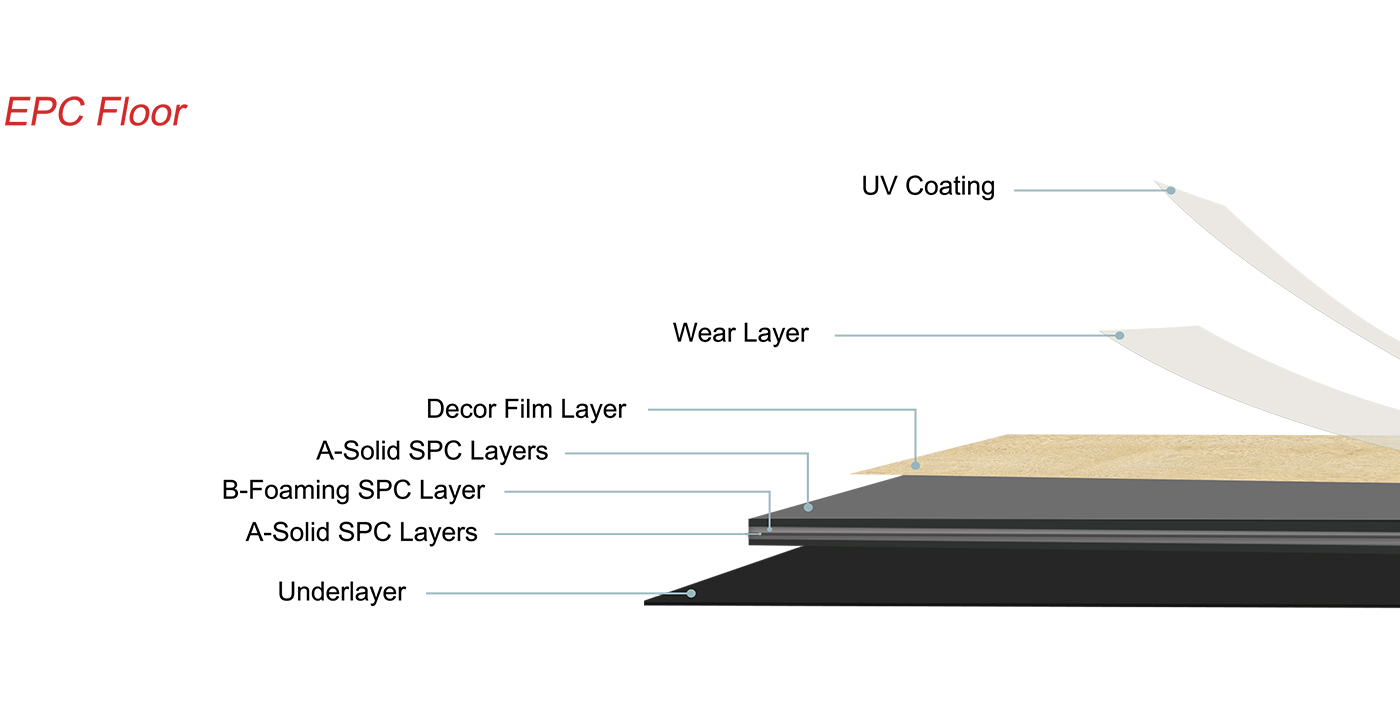
Understanding the anatomy of an EPC floor makes selecting between similar-looking planks much simpler. Every EPC product stacks these five layers in order:
- UV-cured finish coat: A transparent protective film that resists scuffs, scratches, and everyday abrasion. Premium options add an anti-bacterial top layer.
- Wear layer: Measured in mil (a mil equals 0.001 inch), this clear PVC layer absorbs the physical punishment. Residential-grade floors typically use 12 mil (0.3 mm), while commercial-rated products reach 20 mil (0.5 mm) or higher.
- Decorative film: A high-definition printed photograph of wood, stone, or tile. Advanced embossing techniques now synchronize the texture with the printed grain for a realistic, non-repeating pattern.
- Engineered polymer core: The thickest segment, combining rigid PVC with foaming agents to form a lightweight, closed-cell structure that delivers thermal insulation and impact resistance.
- Attached underlayment: Usually pre-bonded IXPE foam (1 mm to 2 mm) that muffles footfall noise and smooths minor subfloor imperfections without a separate roll-out pad.
This construction explains why EPC feels softer under bare feet than stone-based rigid cores: the polymer core itself acts as a cushion, and the optional foam layer adds a second comfort barrier.
Five Critical Benefits That Define EPC Performance
True Waterproof Integrity
Because the core contains zero organic material, water cannot cause swelling or mold growth inside the plank. This makes EPC a top choice for kitchens, bathrooms, laundry rooms, and even below-grade basements where moisture vapor is constant.
Superior Underfoot Comfort
The foamed polymer core yields slightly under pressure, reducing joint fatigue during prolonged standing. Compared to SPC, EPC absorbs impact energy — dropping a glass on EPC results in a bounce rather than a shatter.
Quieter Acoustics
Independent lab tests consistently show EPC reduces reflected walking noise by 6–10 decibels more than stone-composite floors of the same thickness. In condos where HOA rules mandate IIC (Impact Insulation Class) ratings of 50 or higher, EPC often passes without additional sound mats.
Fast, Glue-Free Installation
All EPC planks use an angle-fold click system that locks on all four sides. A proficient two-person team can install 200 square feet in under three hours. There is no dry time, no adhesive odor, and the floor can handle foot traffic immediately.
Stable Over Temperature Swings
While SPC offers slightly better dimensional stability under extreme heat (greater than 40 °F / 4 °C rapid shifts), EPC handles normal residential interior swings without gapping or peaking. In sunrooms where floor temperatures can reach 120 °F (49 °C), EPC with a solid-profile core still maintains expansion under 0.02%.
EPC vs. SPC vs. ABA: The Only Comparison Table You Need
Buyers frequently hear about SPC (Stone Plastic Composite) and ABA (Acoustic Barrier Acoustic) alongside EPC. All three are rigid core vinyl, but each solves a different challenge. The table below distills the key differences into data points:
| Feature | EPC | SPC | ABA |
|---|---|---|---|
| Core Material | Foamed PVC polymer | Limestone + PVC composite | Woven fiber backing + PVC core |
| Density (lbs/ft³) | 35–45 | 70–85 | 50–60 (backing dependent) |
| Waterproof | Yes, 100% | Yes, 100% | Yes, 100% |
| Underfoot Warmth | Moderately warm | Cool to the touch | Warmest due to textile backing |
| Impact Sound Reduction (ΔIIC) | High (8–12 dB) | Moderate (3–6 dB) | Very High (14–18 dB) |
| Dimensional Stability (per °C) | 0.008% | 0.004% | 0.015% |
| Best Use Case | Bedrooms, living areas, basements | High-traffic commercial, sunrooms | Multi-story condos requiring IIC 55+ |
| Typical Plank Thickness | 5 mm – 8 mm | 4 mm – 6 mm | 7 mm – 9.5 mm |
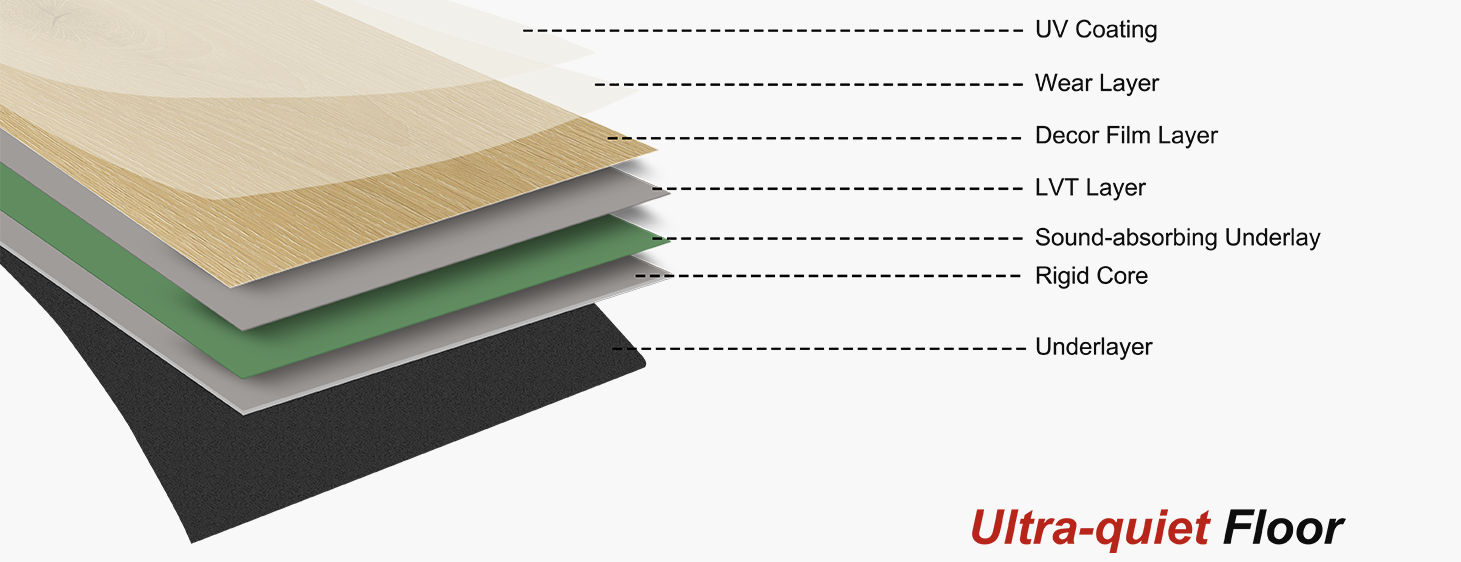
Notice that ABA achieves the best sound scores but trades dimensional stability for that acoustic performance. SPC dominates in density and direct heat resistance. EPC sits in the sweet spot: excellent waterproofing, good sound control, and comfort that neither extreme offers. For deeper multi-story condo performance, also explore UltraQuiet flooring systems.
Where EPC Excels — And Where It Does Not
Ideal Applications
- Primary bedrooms, kids’ rooms, and hallways where barefoot comfort matters
- Kitchens and bathrooms with standing water risk and heavy appliance presence
- Basements that stay dry but carry persistent moisture vapor
- Renovations over existing vinyl or tile — EPC planks add minimal height
- Rental properties needing durable, low-maintenance flooring that tenants cannot ruin easily
Less Suitable Scenarios
- Unconditioned three-season porches in climates with 50+ degrees daily temperature swings: SPC or porcelain tile remains safer
- Commercial kitchens or warehouses where forklift traffic and constant heavy rolling loads crush lighter cores
- Areas with direct, prolonged UV exposure through unfiltered glass: the polymer core can soften and expand beyond spec under continuous 130+ °F heat
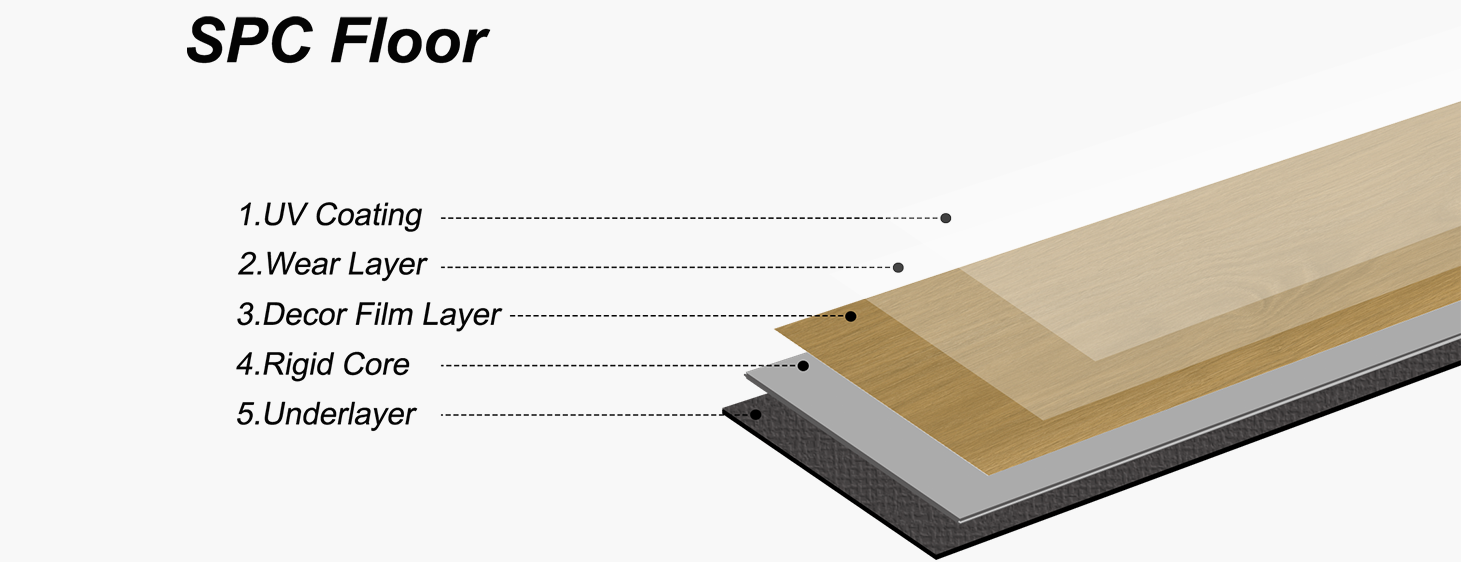
For commercial-grade rigidity in a visually similar plank, an SPC alternative like our SPC click vinyl collection delivers the necessary density without sacrificing waterproofing.
Installation: What You Need Before the First Plank Goes Down
EPC flooring uses a floating floor method. No fasteners touch the planks — the entire floor rests on the subfloor as a single interconnected sheet. This demands proper preparation.
First, level the substrate. The manufacturer specification typically requires a flatness tolerance of 3/16 inch over a 10-foot span. Fill low spots with a portland-based self-leveler; grind high spots with a concrete grinder. Next, condition the planks by stacking unopened boxes flat in the installation room for 48 hours, maintaining interior temperature between 65 °F and 85 °F.
During installation, leave a 1/4-inch expansion gap around all vertical obstructions — walls, pipes, door jambs — and cover the gap with baseboard or quarter-round molding. For rooms wider than 30 feet in any direction, insert a T-molding to break the field and allow independent expansion. Once you lock the final row, the floor is ready for furniture immediately.
Care and Long-Term Durability
Daily maintenance requires a dry dust mop or a vacuum with a hard floor attachment. Do not use a beater bar. For wet cleaning, use a pH-neutral vinyl floor cleaner and a damp microfiber mop — never soaking wet. Avoid steam mops entirely, as the high heat can deform the polymer core and weaken locking joints.
Felt pads under all furniture legs prevent compression scuffs. In entryways, use a walk-off mat to trap abrasive sand that can micro-scratch the wear layer over years. With a 20-mil wear layer, a well-maintained EPC floor in a residential setting routinely lasts 15 to 20 years before visible wear appears.
Making the Right Selection for Your Space
Product lines vary in embossing precision, plank width, and attachable acoustic backings. When comparing EPC products, check three specs first:
- Wear layer thickness in mil. For homes with pets and children, 20 mil is not overkill — it is a long-term investment against daily scratching.
- Plank width and length. Wide planks (7+ inches) create a modern, expansive feel but demand a flatter subfloor. Narrow planks (5 inches) hide subfloor waves better.
- Embossing-in-register (EIR) technology. Products that register texture to the printed grain deliver a realism that standard pressed textures cannot match.
Also consider the attached underlayment thickness. A 1.5 mm IXPE pad adds more sound deadening than a 1 mm pad, but increases installed floor height and may interfere with door clearance. All these variables live within our EPC catalog, so you can filter by exactly the traits your project demands.



LET'S WORK TOGETHER
WELCOME TO JOIN!
-
+86-13616168066
-
[email protected]

-
+86-510-86525168
-
No.8 North Huanzhen Road, Mazhen,Xuxiake Town,Jiangyin City,Jiangsu Province,China
JOIN OUR MAILING LIST
Copyright © 2025 Jiangsu Herewin Environmental Technology Co., Ltd. All Rights Reserved. Vinyl Plank Flooring Manufacturers SPC Rigid Core Flooring Factory
