
 EN
EN
 English
 Español
 عربى
عربى 中文简体
中文简体


-
SPC Flooring: Eco-friendly and Durable, Leading the New Trend in Home Furnishings?
Jul, 31, 2025
Industry NewsIn the modern home environment that pursues greenness, health, and comfort, SPC flooring (Stone Plastic Composite flooring) stands out with its unique advantages, becoming the preferred flooring mater... -
ABA Formaldehyde-free Flooring: An Ideal Choice for Green Homes and Public Spaces?
Jul, 31, 2025
NewsAs an innovative product in the field of environmentally friendly building materials, ABA formaldehyde-free flooring is gradually gaining a foothold in home decoration and various public spaces with i... -
SPC Flooring is Coming for You?
Jul, 31, 2025
Industry NewsSPC stone plastic flooring has been popular in foreign countries such as the United States, Europe, Japan, South Korea, etc. for decades, and has basically replaced laminate flooring. However, in Chin... -
Tips to Keep SPC Flooring Looking New for Years?
Jul, 31, 2025
Industry NewsAs a popular flooring option on the market today, SPC flooring is widely used in both commercial and residential settings. However, long-term daily use can to wear and tear, requiring regular maintena...

-
+86-13616168066

TEL:
-
+86-510-86525168

Fax:
-
No.8 North Huanzhen Road, Mazhen,Xuxiake Town,Jiangyin City,Jiangsu Province,China

Address:
Feel Free To Contact Us :
-
+86-13616168066
-
-

ABA Floor Manufacturers
ABA Click Vinyl Plank Flooring represents the next generation of SPC flooring, combining the proven advantages of SPC with enhanced comfort and longer service life. It is designed to provide both aesthetic appeal and functional durability for modern interiors.
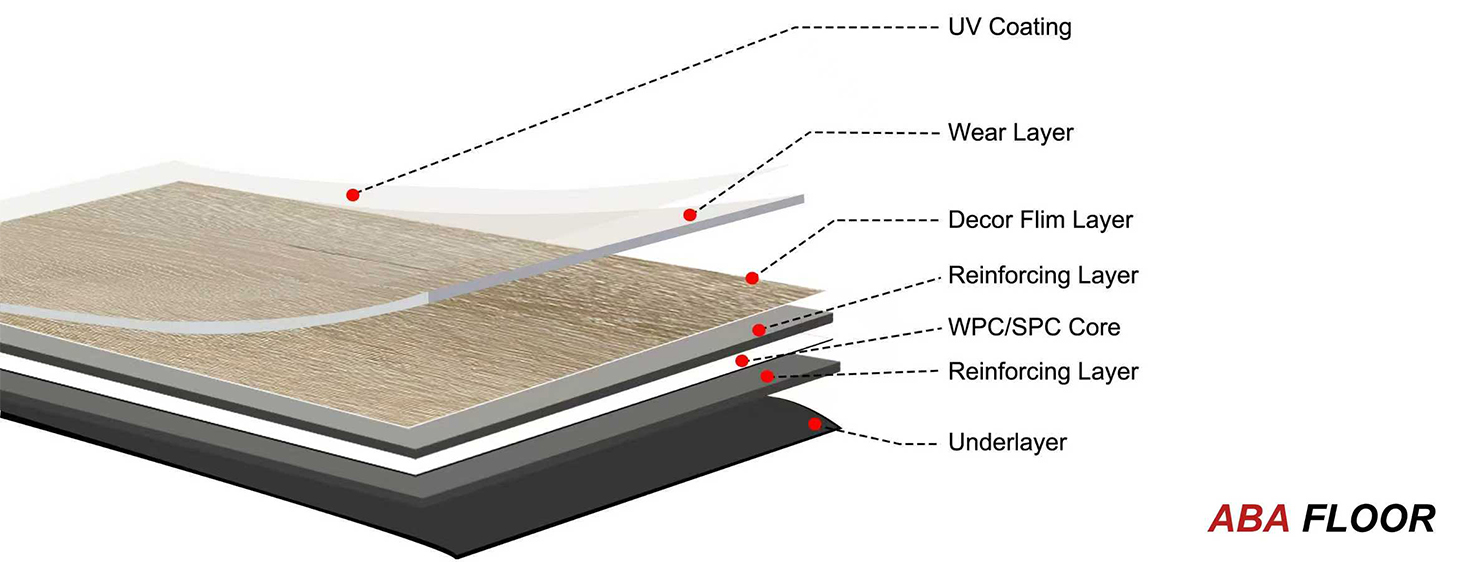
The innovative ABA co-extrusion layer replaces the traditional SPC core, significantly improving dimensional stability and resistance to deformation. This ensures the flooring remains flat and secure even under heavy use.
Unlike other products on the market that claim to be ABA flooring but rely on post-lamination, our ABA flooring is formed in a single process. High temperature and high pressure fuse the materials into a true ABA structure, offering superior stability compared to laminated alternatives.
The flooring delivers an exceptional underfoot experience, offering a softer, more natural feel while maintaining durability. Its design and structure make it suitable for both residential and commercial environments.
The one-step ABA manufacturing process also guarantees long-term reliability, making it an ideal choice for spaces that demand both beauty and performance.
Structural Diagram:
Message Feedback
About Herewin Environmental
Provide Green And Safe Home Decoration Materials
Jiangsu Herewin Environmental Technology Co., Ltd. is a modern manufacturing enterprise focusing on new home decoration materials, integrating R&D, production and sales. As OEM/ODM ABA Floor Manufacturers and ABA SPC Flooring Factory, the products have passed the certification of international authoritative institutions such as SGS and BV, and are exported to many countries and regions, including Europe, Southeast Asia, and the Middle East. Supply Wholesale ABA Structure Light SPC Flooring. Relying on stable quality and flexible cooperation modes, the company has won high trust and recognition from global customers.
Industry knowledge
ABA Floor vs. Traditional SPC: Where the “Added Value” Actually Comes From
“ABA” in ABA Floor typically refers to a three-layer sandwich structure (A/B/A) that places similar materials on the top and bottom with a stabilized core in the middle. In practice, this is used to improve dimensional stability and mitigate internal stress—especially useful in larger planks or environments with bigger temperature swings.
Practical takeaways for buyers
- If you’re choosing wide boards or long planks, ABA structures can help reduce the tendency for “tension set” that contributes to edge lift over time.
- On projects where indoor climate control is inconsistent, the stability benefit can be more noticeable than in small, well-conditioned rooms.
- Ask suppliers to share flatness and dimensional tolerance controls, not just a spec sheet; process control matters as much as structure.
In our export orders, we focus on delivering stable, repeatable output—because on real sites, consistency is what saves labor cost.
Wear Layer Strategy: Choosing Thickness Without Overspending
The wear layer is your functional “working surface.” Many buyers fixate on thickness alone, but the more actionable view is: expected traffic + maintenance habits + rolling loads (chairs, carts, display racks). A slightly thicker wear layer can extend appearance life, but only if the floor is also properly maintained and the subfloor is flat.
| Space Type | Traffic Reality | Buying Tip |
|---|---|---|
| Residential / Apartments | Foot traffic + occasional furniture moves | Prioritize scratch-hiding emboss + easy-clean surface |
| Retail / Showrooms | Abrasive dust + rolling displays | Ask about rolling load performance and chair/caster suitability |
| Offices / Education | Chair movement concentrated in zones | Use mats in chair zones; choose wear layer for zoned stress |
| Light Commercial | More frequent cleaning + heavier point loads | Subfloor flatness often becomes the deciding factor |
If you’re comparing quotes, request the same wear-layer spec and surface treatment across suppliers—otherwise you’re not comparing like-for-like.
Click System Reality Check: “Lock Strength” Is Only Half the Story
Click failures are often blamed on the locking profile, but on-site issues are frequently caused by subfloor flatness, plank dimensional variance, or installation technique. Even a strong click profile can be stressed if the floor is bridging low spots, creating micro-movement under foot traffic.
What to request before you buy
- Production tolerance controls (length/width/thickness) and how often they’re checked during a run.
- Evidence of click-profile consistency over time (e.g., internal QC sampling records).
- Installation guidance that explicitly states subfloor flatness requirements and expansion gaps.
From our side, we treat click stability as a manufacturing discipline—not a marketing slogan—because a smooth install is where buyers feel the value first.
Underlayment Choices: When “More Cushion” Backfires
A common mistake is selecting an underlayment that is too soft. Excessive compression can increase joint movement, amplifying click fatigue and creating noise over time. The right underlayment balances acoustic improvement with sufficient support under rolling and point loads.
Selection checklist
- Choose an underlayment that matches the application: apartments prioritize impact sound; retail prioritizes load stability.
- If the product includes an attached pad, avoid stacking another thick, soft foam unless the flooring specification explicitly allows it.
- In humid regions, confirm moisture-barrier needs and compatible tape/seam methods.
A simple rule on projects: stable support protects the click; acoustics come second if you want long service life.
Subfloor Flatness: The Hidden Spec That Determines 80% of Outcomes
Even high-quality ABA SPC flooring can’t “average out” a bad substrate. Unevenness creates rocking, concentrated stress at joints, and audible squeaks. Many callbacks are installation-condition failures, not product defects.
Practical field habits that reduce risk
- Use a long straightedge to identify high/low areas; grind high spots and fill low spots before laying planks.
- Treat transitions seriously: doorways and corridor junctions often become stress concentrators.
- Maintain expansion gaps at walls and fixed objects—especially in sun-exposed rooms.
On export projects, we’ve seen that better subfloor prep can outperform “upgrading” to a thicker plank in terms of overall satisfaction.
Temperature, Sunlight, and Expansion: What Buyers Should Plan For
SPC is dimensionally stable, but not dimensionless. Large windows, strong sunlight, and uneven room temperatures can still create expansion/contraction cycles. Problems occur when movement is constrained—tight cuts, missing expansion gaps, heavy fixed cabinetry on top of floating floors.
How to design around movement
- Use appropriate transitions for long runs (corridors, large open areas) to reduce cumulative stress.
- Add window shading or UV control in intense sun zones to reduce peak surface temperatures.
- Avoid locking floating floors under heavy fixed furniture unless the installation method is designed for it.
If you share your project layout, we can help align plank size and installation approach to the actual site conditions—small planning choices prevent big headaches.
Slip Resistance and Cleaning: Don’t Accidentally Polish Your Floor
Floor safety and appearance are tightly linked to maintenance. Many “slippery floor” complaints come from residue: overly concentrated cleaners, wax-like products, or incorrect mop practices that leave a film. That film can attract dirt and reduce traction.
Maintenance rules that actually work
- Use pH-neutral cleaners; avoid “shine enhancer” products unless approved for resilient flooring.
- Rinse cycle or clean-water pass in commercial settings where detergent buildup is common.
- Grit control (entry mats) reduces micro-scratching more than any “stronger coating” claim.
A well-maintained surface keeps its texture and color longer, which is why we emphasize practical care guidance along with stable product quality.
Certifications and What They Really Signal to Buyers
Third-party testing can reduce procurement risk, but only if you interpret it correctly. Certifications typically confirm that a tested sample meets certain criteria at the time of testing; they are not a guarantee of every batch unless supported by ongoing QC and traceability.
How to use certificates intelligently
- Ask for the certificate scope: product model, thickness, surface type, and validity date.
- Request batch traceability (lot numbers) and internal inspection routines that connect production to testing.
- Align requirements with your market: Europe, Southeast Asia, and the Middle East often have different buyer expectations and project documentation standards.
Our products are tested by international third parties like SGS and BV, and we pair that with consistent manufacturing controls—so buyers can specify with confidence across multiple regions.
LET'S WORK TOGETHER
WELCOME TO JOIN!
-
+86-13616168066
-
[email protected]

-
+86-510-86525168
-
No.8 North Huanzhen Road, Mazhen,Xuxiake Town,Jiangyin City,Jiangsu Province,China
Copyright © 2025 Jiangsu Herewin Environmental Technology Co., Ltd. All Rights Reserved. Wholesale ABA Structure Light SPC Flooring Factory
