
 EN
EN
 English
 Español
 عربى
عربى 中文简体
中文简体

-
SPC Flooring: Eco-friendly and Durable, Leading the New Trend in Home Furnishings?
Jul, 31, 2025
Industry NewsIn the modern home environment that pursues greenness, health, and comfort, SPC flooring (Stone Plastic Composite flooring) stands out with its unique advantages, becoming the preferred flooring mater... -
ABA Formaldehyde-free Flooring: An Ideal Choice for Green Homes and Public Spaces?
Jul, 31, 2025
NewsAs an innovative product in the field of environmentally friendly building materials, ABA formaldehyde-free flooring is gradually gaining a foothold in home decoration and various public spaces with i... -
SPC Flooring is Coming for You?
Jul, 31, 2025
Industry NewsSPC stone plastic flooring has been popular in foreign countries such as the United States, Europe, Japan, South Korea, etc. for decades, and has basically replaced laminate flooring. However, in Chin... -
Tips to Keep SPC Flooring Looking New for Years?
Jul, 31, 2025
Industry NewsAs a popular flooring option on the market today, SPC flooring is widely used in both commercial and residential settings. However, long-term daily use can to wear and tear, requiring regular maintena...

-
+86-13616168066

TEL:
-
+86-510-86525168

Fax:
-
No.8 North Huanzhen Road, Mazhen,Xuxiake Town,Jiangyin City,Jiangsu Province,China

Address:
Feel Free To Contact Us :
-
+86-13616168066
-
-

Ultra-Quiet Floors Manufacturers
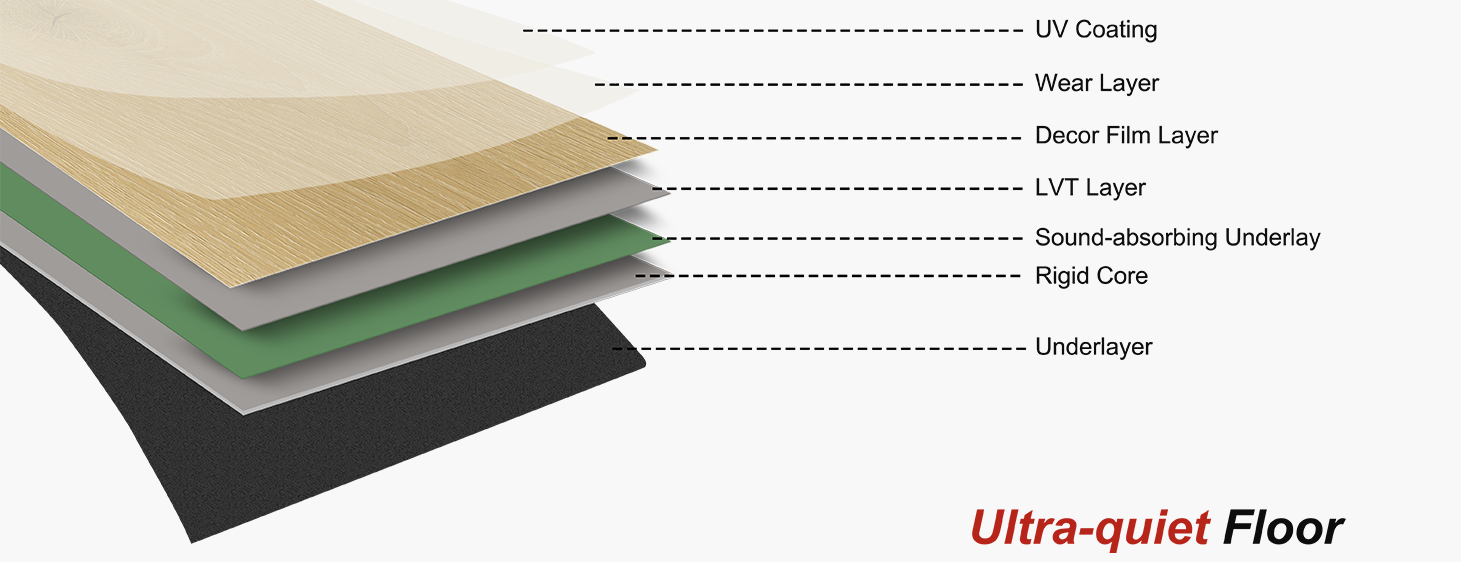
Ultra-Quiet Flooring integrates a soft "comfort layer" under its resilient top surface, elevating sound insulation and walking comfort. It offers a carpet-like underfoot experience with much better acoustics than traditional SPC floor.
Structural Diagram:
Message Feedback
About Herewin Environmental
Provide Green And Safe Home Decoration Materials
Jiangsu Herewin Environmental Technology Co., Ltd. is a modern manufacturing enterprise focusing on new home decoration materials, integrating R&D, production and sales. As OEM/ODM Ultra-Quiet Floors Manufacturers and Soundproof Vinyl Flooring Factory, the products have passed the certification of international authoritative institutions such as SGS and BV, and are exported to many countries and regions, including Europe, Southeast Asia, and the Middle East. Supply Custom Soundproof Vinyl Flooring. Relying on stable quality and flexible cooperation modes, the company has won high trust and recognition from global customers.
Industry knowledge
How “Ultra-Quiet” Is Measured: STC vs. IIC (and Which One Matters)
When buyers ask for ultra-quiet floors, they often mean two different problems: voices/TV through walls and floors, and footsteps moving through the structure. STC (Sound Transmission Class) is mainly about airborne sound; IIC (Impact Insulation Class) is about impact noise like walking, chairs, or dropped items. For multi-story apartments and commercial spaces, IIC is usually the deciding metric.
Practical selection tip
If the complaint is “I hear footsteps above,” prioritize systems that improve IIC. If the complaint is “I hear conversations,” you’ll care more about STC. In my experience supplying project-grade materials, matching the right metric to the real noise type avoids costly rework.
| Metric | Best for | Typical examples | Project implication |
|---|---|---|---|
| STC | Airborne sound control | Voices, TV, music | More relevant to partitions/ceilings and full assemblies |
| IIC | Impact noise reduction | Footsteps, rolling chairs, dropping objects | Often improved by resilient layers + correct installation |
Why Vinyl Can Be Quiet: Damping, Mass, and the “System” Effect
“Soundproof vinyl flooring” is rarely about one material doing everything; quiet performance comes from a flooring system. Vinyl surfaces can contribute to damping (reducing vibration), while a resilient underlayer can decouple the walking impact from the subfloor. What matters is how the surface layer, core structure, underlayment, and subfloor interact.
Key mechanisms buyers can evaluate
- Damping: reduces “ringing” and vibration transmission through the plank/tile.
- Decoupling: a resilient layer limits direct energy transfer into the structure.
- Continuity: gaps, rigid bridges, or tight-to-wall edges can bypass the acoustic layer.
In projects we support across residential and commercial spaces, the quietest outcomes usually come from controlling installation details—not just choosing a “quiet” label.
Built-In Pad vs. Separate Underlayment: When Each Option Works Better
Many vinyl products include an attached pad for convenience. It can help reduce minor impact noise and simplify installation, but it’s not always the best match for every subfloor or project target. A separate underlayment allows you to tune performance and address subfloor conditions more precisely.
Decision guidance for buyers
- Choose built-in pad when you need fast installation and the subfloor is already flat and stable.
- Choose separate underlayment when your spec requires better impact-noise control or your subfloor needs bridging of minor imperfections.
- Avoid stacking multiple soft layers unless the flooring system explicitly allows it—over-compliance can cause joint stress and movement noise.
If you’re sourcing for apartments, hotels, or office refits, I often recommend confirming the permitted underlayment types early—this prevents warranty conflicts later.
The #1 Cause of “Still Noisy” Floors: Acoustic Bridging at the Perimeter
Even with the right materials, quiet floors can fail if vibration finds a rigid path around the resilient layer. A common culprit is tight contact between flooring and walls, door frames, columns, or fixed cabinetry—this creates acoustic bridges.
What to check on-site
- Maintain a clean perimeter gap (per product guidance) so the floor can float without hard contact.
- Use trims that don’t pin the floor down; avoid over-fastening into the floating field.
- Around pipes and thresholds, seal thoughtfully—rigid fillers can re-create a vibration pathway.
This is one of those “small details, big difference” items. When we ship to demanding markets, we always emphasize perimeter detailing because it often determines whether the space feels truly ultra-quiet.
Click-Lock Noise: How to Reduce “Ticking” and “Hollow” Sound Underfoot
Some floating click floors develop a “ticking” sound at joints or a “hollow” acoustic signature. This is usually not a vinyl problem alone—it’s a flatness, movement, or friction issue within the assembly. The quickest improvement often comes from subfloor prep and correct underlayment pairing.
Root causes and fixes
| Symptom | Likely cause | What to do |
|---|---|---|
| Tapping/ticking at seams | Micro-movement from uneven subfloor or tight perimeter | Improve flatness; confirm expansion gaps; avoid pinning with trims |
| Hollow sound | Void areas or too-soft underlayer under a rigid click system | Use approved underlayment; address low spots; ensure full contact |
| Creaking near doorways | Threshold bridging or fasteners restricting float | Rework transitions to keep the floating field free to move |
Quiet Floors in Wet Areas: Managing Moisture Without Sacrificing Acoustics
In kitchens, corridors, or ground-floor units, moisture management and sound control must be planned together. Some underlayments that improve comfort can also trap moisture if the vapor strategy is wrong for the slab or climate. The goal is to prevent mold risk while keeping the acoustic layer effective.
Constructive checks before installation
- Confirm whether the subfloor is on-grade concrete; slabs often require a clear vapor-control approach.
- Use only underlayments and moisture layers that the flooring system permits—compatibility matters for both performance and warranty.
- Keep seams sealed and details consistent; discontinuities can become moisture paths and acoustic weak points.
When we supply export projects, we treat moisture design as part of the acoustic solution—because a quiet floor should also remain stable long-term.
Underlayment Trade-Offs: Impact Noise vs. Rolling Loads and Durability
A softer underlayer can improve comfort and reduce impact noise, but extreme softness may reduce support under rolling loads (chairs, carts) and stress click joints. The right balance depends on use-case: residential bedrooms are different from retail aisles or office chair zones. A good rule is to prioritize stable support wherever frequent rolling occurs.
Where buyers often underestimate loads
- Open-plan offices with task chairs (repetitive rolling concentrates wear).
- Corridors and reception areas (high traffic + cleaning equipment).
- Apartments with frequent furniture rearrangement or strollers.
If you share your use scenario with us, I typically recommend a configuration that preserves joint integrity while still delivering a noticeably quieter step.
LET'S WORK TOGETHER
WELCOME TO JOIN!
-
+86-13616168066
-
[email protected]

-
+86-510-86525168
-
No.8 North Huanzhen Road, Mazhen,Xuxiake Town,Jiangyin City,Jiangsu Province,China
Copyright © 2025 Jiangsu Herewin Environmental Technology Co., Ltd. All Rights Reserved. Custom Soundproof Vinyl Flooring Factory
