
 EN
 English
 Español
 عربى
 中文简体


-
+86-13616168066

TEL:
-
+86-510-86525168

Fax:
-
No.8 North Huanzhen Road, Mazhen,Xuxiake Town,Jiangyin City,Jiangsu Province,China

Address:
Feel Free To Contact Us :
-
+86-13616168066
-
-

Nov. 19, 2026
Industry News
How Wood-Look Flooring Earns Realism: Texture, Grain Alignment, and Plank Variety
Content
Two planks can carry the same oak photograph, the same 1220 mm length and the same click edge, and still look nothing alike once afternoon light rakes across them. The photograph is rarely the problem. What separates a floor that reads as timber from one that reads as plastic is the texture pressed over the print, whether that texture follows the grain lines underneath, and how many distinct plank faces the carton actually holds.
3 mm Maximum flatness deviation over 2 m of subfloor
8-10 mm Perimeter expansion gap left at every wall
6-12 Unique plank faces in a well-specified carton
What Wood-Look Flooring Actually Is
Wood-look flooring is any plank or tile whose visible face reproduces timber grain through a decor layer, a veneer or a glaze, rather than a solid board cut from a log. Most of what ships today is printed: a decor film pressed onto a composite core, then sealed under a transparent wear layer that takes all the abuse.
Definition
A wood-effect floor is a layered product in which appearance comes from an image plus a texture, while performance comes from the core and the wear layer. Realism and durability are separate properties, decided by separate layers, which is why a beautiful plank can still wear through in a hallway.
That separation matters when you are comparing quotes. Two planks can list the same thickness, the same click profile and the same species name while sitting at opposite ends of the realism scale, because the only layer a buyer actually sees is a fraction of a millimetre thick. The decor itself is cheap to change and expensive to get right. A plant can print a hundred oak tones from one press; getting the texture to follow each one is the harder engineering problem.
The wood pattern collection behind a single core usually covers cathedral grain, walnut, beech, washed oak and pale oak, and each of those tones behaves differently under a real light source. Pale decors forgive texture errors. Dark ones expose every flat spot, so a smoky brown oak is the honest test piece when you are judging quality.
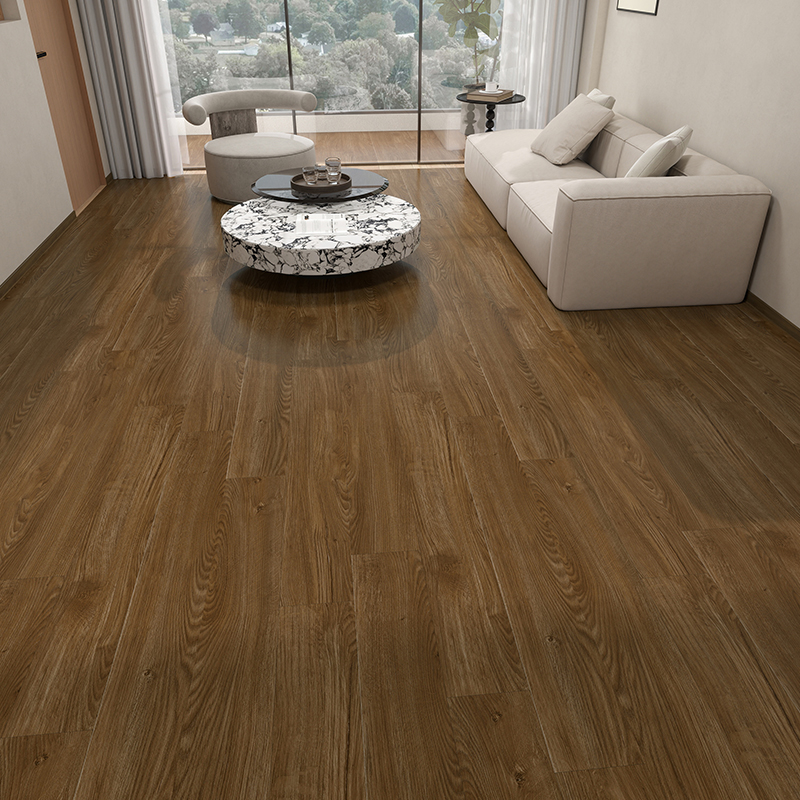 Natural Oak SPC Click Vinyl Plank FlooringNatural oak-look SPC click plank with brushed or EIR texture options, UV coating and Valinge click installation, offering a practical reference for comparing wood-look flooring families.View Product →
The Main Families Compared
Five product families account for nearly all wood-look flooring sold for homes, and they differ far more in behaviour than in appearance. Appearance is a purchasing decision; behaviour is a ten-year decision.
| Family | Core | Water at seams | Underfoot | Realism ceiling |
| Rigid SPC | Limestone and PVC | Waterproof core | Firm, slightly cool | High with EIR |
| Foamed EPC | Foamed polymer | Waterproof core | Softer, warmer | High |
| Laminate | HDF board | Swelling risk | Hard, hollow | Very high print |
| Engineered wood | Plywood plus veneer | Tolerant, not proof | Warm and solid | Genuine timber |
| Porcelain plank | Fired clay | Waterproof | Hard and cold | Good, with grout |
Budget usually decides the family before realism does. Engineered wood sits at the top of the price band and brings humidity management with it. Laminate occupies the middle and asks you to respect its seams. Rigid and foamed cores sit below both and ask almost nothing except a flat subfloor, which is why they now dominate kitchens, rentals and renovation projects where the existing floor stays in place.
What Makes a Wood Effect Convincing
Texture registration, surface gloss and pattern repeat decide whether a wood-look plank reads as timber; print sharpness matters far less than buyers expect.
Embossed in register, shortened to EIR across the industry, means the steel plate that presses texture into the wear layer is cut from the same digital file as the print. Grain lines, knots and saw marks receive a physical depression exactly where the image shows them. Without registration the texture is generic, a uniform stipple that reads as plastic from two metres away, no matter how many pixels went into the picture. You can check this in a showroom in ten seconds by dragging a fingernail across a dark grain line, then across a light area between lines. If both feel identical, the texture is not registered. The embossed-in-register range exists precisely to close that gap.
A matte surface with ordinary print quality and correctly registered texture will beat a razor-sharp print on a flat, glossy film every single time.
- Gloss level: aim for 5-10 gloss units. Anything above 20 records every footprint and every dog paw.
- Unique plank faces: 6-12 per carton prevents the obvious repeating board across an open room.
- Plank format: 190 x 1220 mm and larger. Short, narrow planks start to read as ceramic tile.
- Edge detail: a genuine micro-bevel separates boards visually. Painted bevels chip at the corners.
- Tone variation: several light-to-dark faces per carton mimic a real tree instead of a photocopy.
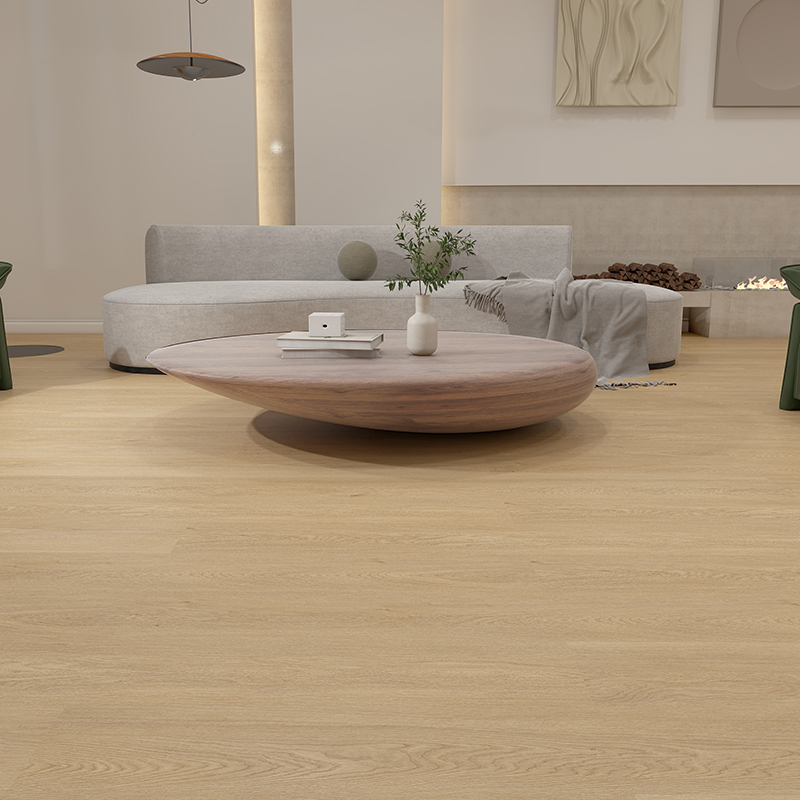 Light Natural Oak EIR Ultra-Quiet Click Vinyl PlankEmbossed-in-register light oak click plank with aligned grain texture, reduced walking noise and Valinge click installation, worth viewing when registered texture matters more than decor names.View Product →
Reading the Spec Sheet Before You Buy
Wear layer thickness, core thickness and your subfloor flatness determine how a wood-look floor performs; the decor name tells you almost nothing useful.
Wear layer guidance by traffic load
Figures reflect common market ranges and typical usage, not a single standard.
Wear layer is measured both in millimetres and in mils, which causes endless confusion at the counter. Twelve mil is roughly 0.30 mm, twenty mil is roughly 0.50 mm. A 0.20 mm layer is fine in a spare bedroom and a poor choice in a hallway with three children, even though both planks may carry the same lifetime wording on the box.
Core thickness runs from about 4 mm to 8 mm in rigid products. Thicker cores bridge minor subfloor variation, reduce the hollow sound underfoot and accept a longer click profile, but they also raise the finished floor height, which matters at door thresholds and at the junction with an existing tile slab.
Matching the Core to the Room
The rigid and foamed cores look identical in photographs and behave very differently once installed, so the room should pick the core rather than the other way round.
Rigid SPC core
- Best over heated slabs, large open plans and 10 m runs
- Minimal expansion, so fewer transition strips
- Firm underfoot; pair with a thin acoustic underlay
- Scores and snaps cleanly on most 4-5 mm planks
Foamed EPC core
- Better impact sound, warmer to bare feet
- More forgiving over slightly uneven existing floors
- Slightly more movement; keep expansion gaps honest
- Strong choice for upper floors and apartment buildings
Tone selection follows the same logic as the core. A whitewashed oak lifts a north-facing room with limited daylight; a smoky brown reads warm under artificial light but can look heavy in a narrow corridor. If you cannot see a full room of the plank, buy one box and lay eight boards side by side on the actual floor before committing.
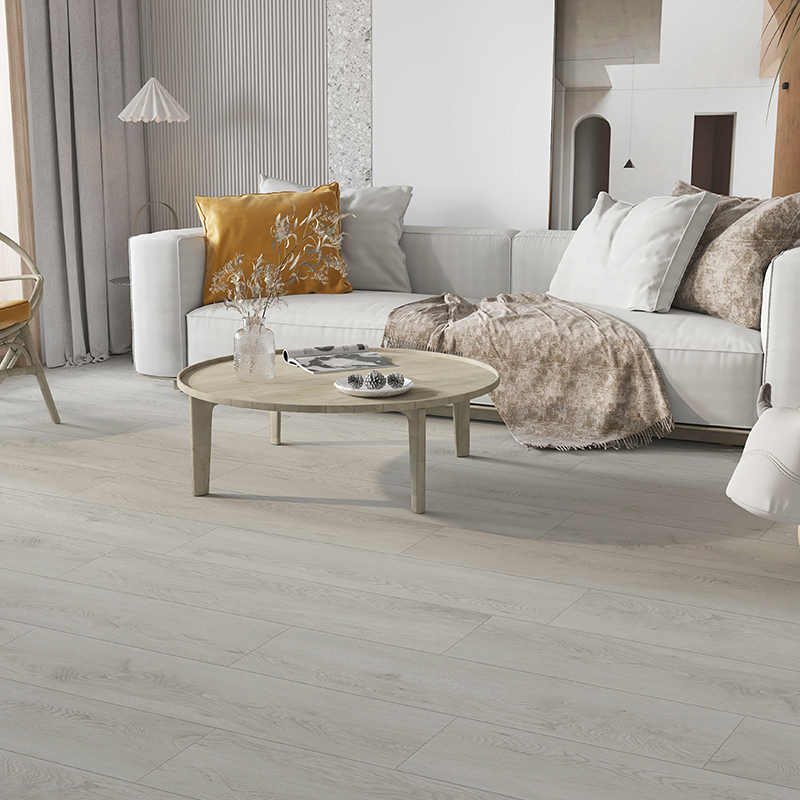 Whitewashed Oak SPC Click Vinyl Plank FlooringWhitewashed oak-look SPC click plank with brushed or EIR texture options, UV coating and waterproof construction, useful for judging how a pale oak tone suits the room.View Product →
Installation Reality
Almost every complaint about a wood-look click floor traces back to the subfloor or the expansion gap, not to the plank itself.
-
Check flatness first
Lay a 2 m straightedge across the room in both directions. Any gap greater than 3 mm needs levelling compound or a skim, because a rigid core will rock, and rocking planks open their click joints within a season.
-
Let the cartons rest
Stack them flat in the room for 24 to 48 hours at roughly 18-27 C. Rigid cores need less time than laminate, but the planks should match the room before they are joined.
-
Plan the layout
Run planks along the main light source, stagger end joints by at least 200 mm, and cut the first row so the last row is never narrower than 50 mm.
-
Leave the gap
Keep 8-10 mm at every wall, pipe and door frame. Floating floors move as one slab, and a floor pinned at two sides will gap in the middle of the room.
-
Fit trims last
Skirting, scotia and thresholds go on after the floor is down, never before, and they must float over the gap rather than press into the plank edge.
A Short Buying Checklist
Six checks cover the difference between a wood-look floor that still looks like wood in five years and one that does not.
- Wear layer matches the room's traffic, not the room's name on the box
- Texture registered to the print, verified with a fingernail in the showroom
- Gloss under 10 units, checked under a window rather than under showroom spotlights
- At least six distinct plank faces per carton
- Core thickness suits the finished floor height at thresholds
- Click profile and warranty documentation available before payment
Questions Buyers Ask
Does a wood-look vinyl floor fool people up close?
At one metre, most people judge the texture before the print. A registered, matte surface with visible grain relief passes casual inspection; a flat glossy film fails immediately, even when the photograph underneath is sharper. Close-up realism is a texture question, not a resolution question.
Can a wood-look plank go straight over existing tile?
Yes, provided the tile is sound, firmly bonded, and the grout lines are filled and levelled first. Grout joints telegraph through a thin rigid core within months, so a skim coat or a 1.5 mm underlay is standard practice on any tiled substrate.
Which wood-look floor handles dogs best?
Look for a wear layer of 0.50 mm or more, a matte finish and a rigid core. Claws mark gloss surfaces long before they mark the print, and a harder core spreads point loads instead of flexing the click joint open.
Is a thicker plank always better?
Not automatically. Extra thickness buys stability, sound dampening and tolerance of a mediocre subfloor, but it also raises the finished height and the cost. If the subfloor is genuinely flat and the room is quiet, a 5 mm plank with a good wear layer outperforms an 8 mm plank with a poor one.
The floor you will still like in five years is the one with an honest wear layer, a texture that follows its grain, and a subfloor that was checked before a single plank was clicked into place.


LET'S WORK TOGETHER
WELCOME TO JOIN!
-
+86-13616168066
-
[email protected]

-
+86-510-86525168
-
No.8 North Huanzhen Road, Mazhen,Xuxiake Town,Jiangyin City,Jiangsu Province,China
JOIN OUR MAILING LIST
Copyright © 2025 Jiangsu Herewin Environmental Technology Co., Ltd. All Rights Reserved. Vinyl Plank Flooring Manufacturers SPC Rigid Core Flooring Factory
